Author: admin

  • Why Brand Strategy Matters for Startups

    Why Brand Strategy Matters for Startups

    Most founders I sit down with are juggling too much at once. Product feels urgent. Hiring feels urgent. Revenue feels urgent. The brand gets pushed aside because it does not feel like it moves anything right now.

    I get it. I have been in those conversations where branding sounds like a later problem. But here is what actually happens. You launch, things start moving, and then you realize people do not really understand what you do. Or worse, they have formed the wrong idea entirely, and you did not catch it until it started costing you.

    Fixing that later always costs more. More time, more money, and more confusion inside the team that is harder to untangle than it looks. So let us go through why brand strategy matters for startups and what actually changes when you get it right before you need it.

    Brand Strategy Gives Your Startup a Direction Before You Need One

    Early on, most founders want to keep their options open. They do not want to lock themselves into one direction too soon. That instinct makes sense, but it quietly creates a different problem. You end up moving in five directions at once without noticing until the damage shows up somewhere unexpected.

    Earlier this year, I worked with a founder who kept shifting their messaging depending on who was in the room. Investors heard one story. Customers heard another. The product team was building toward something else entirely. Nothing was technically wrong, but nothing lined up either. And that gap costs you more than most people realize.

    Brand strategy earns its place by forcing a few key decisions earlier than you might feel ready for. Who exactly is this for? What problem do you want to be known for solving? Where do you actually sit in the market? Founders worry that answering those questions too early will trap them. In reality, it gives you a foundation to build on. Without it, every decision just feels like another guess.

    The startups that define this upfront move faster later. They are not rewriting their story every few months or second-guessing whether they are talking to the right people. They already know. So they just build.

    It Tells Customers Exactly Why They Should Choose You

    Most startup websites start blurring together after a while. Same tone. Same claims. Same vague language about being better, smarter, or faster than whoever came before.

    Customers feel that even when they cannot explain why. When there is no clear position, they hesitate. They compare you with others, and nothing stands out enough to make the decision feel obvious. So they wait, or they go somewhere else.

    I reviewed a SaaS product a while back that genuinely solved a painful problem. The product was solid. The team understood their market. But the messaging was trying to reach everyone at once, so it ended up landing with no one in particular. We narrowed the focus to a specific user and reframed how they described the core problem. Nothing else changed. Same product, same price point. Conversions improved within a few weeks.

    That is what a sharp brand strategy actually does. It makes your value obvious instead of implied. And when customers get it quickly, they decide faster. That is the part most founders do not expect.

    Investors and Partners Pay Attention to How You Show Up

    Pitch rooms tell you a lot. Within a few minutes, you can usually sense which teams have clarity and which ones are still working through the fundamentals out loud.

    It is not just about numbers or product features. It is how the story holds together. Founders with clear positioning speak with more precision. Their narrative does not drift. You can see where they fit and where they are headed.

    Strong ideas lose momentum when the positioning feels scattered. The opportunity is visible, but it is not framed in a way that makes it easy to believe in. And that hesitation is hard to reverse once it sets in.

    A startup with a clear identity feels more grounded. More deliberate. That carries into every part of the conversation, including the questions investors ask and the concerns they do not raise.

    Partnerships work the same way. When another company evaluates you, they are really asking one question. Do these people know what they stand for? If the answer is not obvious pretty quickly, doubt fills that space instead.

    Brand strategy does not close deals. But it removes the friction that slows them down.

    It Makes Every Marketing Decision Easier and Cheaper

    Without a clear brand, marketing becomes a string of experiments with no real filter. You try different messages, different visuals, different channels, and hope something sticks. Some teams burn through significant budget this way. Not because they made bad decisions, but because no foundation was guiding those decisions in the first place.

    Once the brand strategy is defined, the noise quiets down. You know what tone fits. You know what messages to push. You can recognize ideas that do not belong before you spend time developing them.

    It changes how teams work together, too. Designers stop guessing what direction to take. Writers stop rewriting the same message in ten different ways, trying to find the version that feels right. There is a shared understanding that speeds the whole thing up and cuts the revision cycles that nobody enjoys.

    Less wasted spend. Fewer rounds of feedback. More focus on what actually works. That efficiency is quiet, but it adds up fast.

    Your Team Builds Better When They Know What the Brand Stands For

    Brand is not just external. It shows up inside the team in ways most founders do not expect until they see it.

    I worked with a startup where the product team and marketing team kept pulling in different directions. Both were doing real work. But they were not aligned on what they were building toward, and that friction showed up in small decisions that slowed everything down week after week.

    Once we clarified the positioning, something shifted. Conversations got shorter. Decisions got easier. People had a clearer picture of what they were aiming for, so they stopped relitigating the same debates.

    It affects hiring, too. When your brand is clear, the right people recognize it and want to be part of it. You spend less time over-explaining your vision in every interview. And the product gets shaped by it as well. The way you position your brand influences what you build, what you prioritize, and what you are willing to leave out. Most founders do not expect brand strategy to reach that far inside the company. But once it is in place, you feel it in the day-to-day.

    It Compounds Over Time in Ways That Paid Ads Cannot

    Paid channels are useful, especially early. They get attention fast. But the moment you stop spending, that visibility disappears with it.

    Brand works differently. It builds slowly, then starts carrying weight on its own.

    Some startups with modest budgets have built real traction simply because their message was clear and stayed consistent. People remembered them. They talked about them. Referrals came without anyone asking for them. That kind of momentum does not come from a campaign. It comes from repetition and clarity held together over time.

    And once it builds, it becomes difficult to compete with. You are not just another option in the market anymore. You are the name people associate with a specific problem or idea. That is when a brand becomes an asset, something that keeps working even when you are not actively pushing it.

    Where Most Startups Go Wrong With Branding

    The most common mistake is jumping straight into design. A logo gets made, colors get picked, a website goes live, and the team moves on, assuming branding is handled.

    But without a strategy underneath those elements, they do not carry meaning. They look fine. They just do not communicate anything specific, and that gap shows up eventually.

    Copying competitors is the other pattern I see regularly. It feels safe, especially in crowded markets. But it leads to sameness. You blend in rather than stand out, and blending in is expensive when your marketing has to work twice as hard to get noticed.

    Then there is the belief that branding is a one-time task. Do it once, move on. That rarely holds as the business grows. The brand needs to evolve alongside the company, but it needs a solid starting point to grow from, or the evolution becomes chaos.

    At minorchange.studio, brand strategy is where every project begins, not where it ends. The work focuses on positioning, audience clarity, and messaging before any design decisions are made. It is a structured process built around real decisions, not just deliverables that look good in a presentation.

    Brand strategy is not something you add later once the business finds its footing. It is part of building something people understand and trust from the start.

    You do not need everything figured out. But you do need clarity. And the sooner you have that, the easier the rest of it becomes.


    Frequently Asked Questions


    When should a startup invest in brand strategy?

    Before you go public with your product is the honest answer. You do not need a full brand system from day one, but you do need clarity on who you are targeting and how you are positioning yourself in the market. Waiting usually leads to rework once traction starts building and rebuilding messaging, repositioning a website, and realigning a product direction after the fact takes far longer than getting it roughly right early on.


    What is the difference between a brand strategy and a logo?

    A logo is one small piece of a much larger picture. Brand strategy sits underneath everything else. It defines your audience, your position in the market, and how you communicate across every touchpoint. Without that foundation, a logo is just a visual mark with nothing specific behind it. When the strategy is clear first, the logo becomes a reflection of something consistent and intentional rather than just something that looks nice.


    How much does brand strategy cost for a startup?

    It varies depending on how deep you go and who you work with. Some founders work through positioning and messaging on their own with good results. Others invest in a structured process with a studio or consultant. The more useful question is what it unlocks. A strong strategy shapes marketing, product direction, and conversion, so the return tends to show up across multiple areas over time rather than in one obvious place.


    Can a startup do brand strategy without hiring an agency?

    Yes, particularly in the early stages. Founders can work through the core questions around positioning and messaging on their own. The real challenge is perspective. It is genuinely hard to see your own blind spots from the inside. An external partner asks different questions and pushes for clarity in areas founders tend to avoid or assume are already resolved. That outside view often surfaces the most valuable work.


    How long does it take to develop a brand strategy for a new business?

    Most focused projects take somewhere between a few weeks and a couple of months, depending on how quickly decisions get made and how thorough the research phase needs to be. Rushing through it in a week tends to produce something that feels right initially but does not hold up as the business grows. The goal is not speed. It is clarity that stays useful as things evolve.


     

  • What Are Brand Name Normalization Rules (Simple Guide)

    What Are Brand Name Normalization Rules (Simple Guide)

    You’ve probably seen this before without realizing it. You search for a brand and find multiple versions of the same name showing up. One says “Amazon,” another says “Amazon.com,” and a third says “AMAZON.” It feels minor, but it creates real confusion fast.

    Now imagine that same mess inside your own systems. Your reports are split. Your SEO weakens. Your data loses clarity. That’s where brand name normalization rules come in. They quietly fix something most teams ignore until it starts costing them traffic and revenue.

    What does brand name normalization actually mean in simple terms?

    Brand name normalization means forcing all variations of a brand into one consistent format across your systems.

    Think about a company like Amazon. People might enter it as “Amazon,” “amazon,” “Amazon.com,” or even “Amazon Inc.” If your system treats each of these as separate, your data becomes fragmented.

    In a real project I worked on, a retailer had four versions of “Walmart” in their product catalog. “Walmart,” “Wal Mart,” “Walmart Inc,” and “WALMART.” Their analytics tool counted each one separately. Once we normalized everything to “Walmart,” their reporting finally matched reality.

    Normalization sets one official version of a brand name and maps every variation to that version. It removes confusion at the source instead of trying to fix it later.

    Why do businesses actually need this, and what breaks without it?

    Most businesses don’t think about this until something goes wrong.

    Picture an ecommerce store selling across the US, UK, and Canada. Suppliers upload products and type brand names manually. One supplier writes “Tesco,” another writes “Tesco PLC,” and someone else enters “TESCO.”

    Your system now thinks these are different brands. Your product filters break. Your search results feel inconsistent. Your SEO pages start competing with each other.

    I’ve seen Shopify stores create duplicate brand pages without realizing it. Instead of one strong page for “Nike,” they end up with multiple weak pages like “nike,” “Nike Inc,” and “NIKE.” Google spreads authority across them, which hurts rankings.

    It doesn’t stop at SEO. Your marketing reports split performance data across different versions of the same brand. Your CRM duplicates records. Your paid ads might even target the same brand multiple times under different spellings.

    When you operate across markets like the US and UK, this gets worse. Regional naming differences add more variation. Without brand data normalization, your systems lose alignment fast.

    What are the core brand name normalization rules you should follow?

    This is where most guides stay surface-level. Real systems need clear rules that you apply consistently.

    You start by defining a canonical version for each brand. This becomes your single source of truth. For example, you might choose “Procter and Gamble” instead of “P&G” or “P and G.” Every variation maps to that version.

    Then you standardize casing. Some systems convert everything to lowercase during processing, then display the correct format. Others store the exact canonical version. Either way works as long as you stay consistent.

    Punctuation comes next. You remove or standardize characters like periods, commas, and ampersands. “H&M” might normalize internally to “H and M,” even if you still display it as “H&M” on the front end.

    Spacing plays a bigger role than most people expect. Extra spaces or missing spaces can create duplicates. A simple rule that trims and standardizes spacing can prevent a lot of issues.

    Legal suffixes often create noise. Words like “Inc,” “Ltd,” or “LLC” rarely add value in search or reporting. Most systems remove them during normalization, so “Apple Inc” and “Apple LLC” become just “Apple.”

    Abbreviations need careful handling. Some brands exist primarily as abbreviations like “IBM.” In these cases, you map full names and short forms to one preferred version instead of trying to convert one into the other unquestioningly.

    Finally, you handle aliases. This is where experience matters. For example, “Facebook” and “Meta” may need a defined relationship depending on your system. This step separates basic setups from well-designed brand naming standards.

    How does normalization work in real databases and ecommerce systems?

    Let’s walk through a scenario that mirrors how this works in practice.

    Imagine you run a marketplace similar to Amazon or a multi-vendor Shopify store. Sellers upload products daily and enter brand names manually. You have no control over how they type them.

    A seller uploads a product and types “Sony Corp.” Another seller enters “SONY.” A third writes “Sony Electronics.”

    Without normalization, your database stores three separate entries. Your filters break—your analytics split. Your users get inconsistent results.

    Now introduce a normalization layer.

    When a seller submits a brand name, your system first cleans the input. It trims spaces, standardizes casing, and removes unnecessary punctuation. Then it checks the cleaned version against your canonical brand list.

    If it finds a match, it replaces the input with the official version, like “Sony.” If it doesn’t, it flags the entry for review or adds it as a new brand after validation.

    Behind the scenes, many systems store both the original input and the normalized version. This helps with auditing and debugging later.

    This setup also improves SEO performance. Instead of creating multiple URLs like “/brand/sony-corp” and “/brand/sony-electronics,” your system generates one clean page like “/brand/sony.” All authority flows into one page, which strengthens rankings.

    Marketing systems benefit, too. Your campaign targeting becomes cleaner. Your reporting becomes accurate. Your audience segmentation improves because your data finally aligns.

    How do you start applying brand-name normalization rules without overcomplicating it?

    You don’t need a complex system to begin.

    Start by identifying your most important brands. Define a canonical version for each one. Then apply simple rules for casing, spacing, and punctuation. Even this basic setup will clean up a large portion of your data.

    As your system grows, expand your brand dictionary. Add known variations and aliases based on real data. This process evolves. No static list will cover everything.

    Be careful with over-normalization. I’ve seen teams strip too much detail and lose meaning. For example, merging “Apple Music” into “Apple” might break product-level reporting. Context always matters.

    You’ll also need a review process. Automated rules handle most cases, but some entries will always need human judgment. A simple approval workflow can prevent long-term issues.

    One more thing people often miss is user experience. If you change what users type too aggressively, it can feel confusing. A better approach keeps normalization behind the scenes while showing clean, consistent names on the front end.

    Questions People Usually Ask About Brand Name Normalization Rules

    What is the difference between brand name normalization and brand naming standards?

    Brand naming standards define how a brand should appear. Brand name normalization enforces that standard across your systems. One sets the rule, the other applies it. You need both to maintain product name consistency and clean data.

    Does brand name normalization help with SEO?

    Yes, it directly impacts SEO. When you normalize brand names, you avoid duplicate pages and split authority. For example, instead of multiple pages for “Nike” variations, you build one strong page that ranks better in Google across markets like the US and UK.

    How does normalization affect ecommerce platforms like Shopify or Amazon-style stores?

    It keeps product listings organized and searchable. Without it, filters break, and users struggle to find products. With proper ecommerce brand naming, your catalog stays clean, and your search results feel consistent.

    Can small businesses benefit from brand data normalization, or is it only for large companies?

    Small businesses benefit just as much, sometimes even more. Early consistency prevents future chaos. If you run a growing store in Canada or Australia, setting this up early saves you from fixing messy data later.

    What tools or systems are used for name standardization in databases?

    Most systems use a combination of validation rules, lookup tables, and mapping logic. Some teams build custom scripts, while others use CRM or ERP tools with built-in normalization features. The key is consistency, not the tool itself.

    Is it okay to remove things like Inc or Ltd during normalization?

    In most cases, yes. These suffixes don’t add much value for search, reporting, or filtering. Removing them helps simplify brand data normalization, especially when dealing with global datasets across multiple English-speaking markets.

  • How Minor Change is Shaping Northern California’s Nightlife Through Culture-Fusion Events

    How Minor Change is Shaping Northern California’s Nightlife Through Culture-Fusion Events

    Introduction

    Northern California’s nightlife is changing fast, and a lot of that shift is happening because local brands are stepping up in ways big entertainment companies don’t. People are looking for nights that feel personal, creative, and full of cultural energy instead of the usual club routine. That’s where Minor Change comes in. The brand has been building its name through design work, storytelling, and community-focused creativity, and now it’s becoming part of the nightlife heartbeat too. One of the clearest examples is the upcoming Hollywood X Bhangra Night, happening on December 27 at Journeys in Downtown Vacaville. It’s the kind of event that blends music styles, cultures, and communities all in one room, and it shows exactly how local brands can help shape the future of nightlife in the region.


    Northern California Wants Something Different Now

    People across Vacaville, Sacramento, and the Bay Area aren’t chasing the usual club vibe anymore. They want energy, but they also wish to make a difference. They like music that reflects who they are, where they come from, and what they’re into right now. That means mixing hip hop with Punjabi pop, or putting Bollywood beats next to Top 40 tracks. It sounds simple, but it creates a completely different feeling inside a venue. When a crowd hears sounds from other parts of the world in the same set, it brings people together in a way traditional nightlife doesn’t.


    This shift isn’t random. Northern California is packed with communities that express culture through music, fashion, and social gatherings. Young people especially want something that feels like them. The rise of cultural fusion nights shows exactly that. These events aren’t just about partying. They’re about connecting with friends, meeting new people, and feeling represented. And because of that, the region has become the perfect place for events that mix styles, genres, and backgrounds. Hollywood X Bhangra Night fits right into that movement.


    What Minor Change Actually Brings to Events

    Minor Change isn’t the typical sponsor that puts a logo on a flyer. The brand comes from a background of design, strategy, and visual storytelling, so their involvement adds a real creative layer to events. When they partner with promoters, they focus on the experience, the branding, and the message behind the night. That’s a big deal, because events today aren’t only judged on the music. They’re judged on how they look, how they’re promoted, how they feel the moment you walk in, and how well the community connects to them.


    Minor Change uses its design approach to help events stand out in an authentic way. They work with local talent, support the creative direction, and help shape the identity of a night. That means the marketing looks sharp, the visuals inside the venue match the theme, and the event has a clear personality instead of feeling generic. For cultural fusion events, this kind of involvement matters even more because the crowd is showing up for both the music and the cultural story behind it. Minor Change helps keep that story real.


    Hollywood X Bhangra Night Shows What’s Possible

    Hollywood X Bhangra Night is one of the best examples of how cultural fusion events are influencing Northern California nightlife right now. The event is set for December 27 at Journeys in Downtown Vacaville, which is becoming a reliable spot for culturally driven nights. The music lineup alone sets the tone. You’ll hear hip hop, Top 40 hits, Bollywood tracks, Punjabi pop, and everything in between. DJ Endless and DJ Switch are running the night, and both DJs are known for blending global sounds with modern club energy.


    The atmosphere expected for this event is the kind of high-energy environment people are looking for. You get stylish crowds, music from multiple cultures, and a setting that feels social rather than stiff. Minor Change’s influence will show through the event visuals, the way the night is branded, and the way the promotion has been handled across social media. Everything feels intentional but still natural, and that mix is part of the reason the event is getting attention. This night matters because it’s more than a party. It shows how local communities shape nightlife when they have support from brands that understand them.


    Why Local Brands Hit Different

    Local brands bring a level of authenticity you can’t fake. They live in the same cities, know the same crowds, and understand what people are actually asking for. Big entertainment companies usually think about numbers and scale. Local brands feel about people. Minor Change is part of the community, so the decisions they make connect with real audiences instead of guessing from the outside.


    These brands also help local DJs, hosts, and creators grow. When they invest time and creativity into events, they make room for talent that deserves visibility but might not get it in mainstream nightlife. Social media direction, graphic design, and storytelling from a brand like Minor Change can help an event grow naturally. That’s the difference between sponsorship and partnership. One writes a check. The other actually cares about shaping the experience.


    The Fusion Scene is Growing Fast

    You can feel the rise of cultural fusion events across Northern California. People want global sounds, new experiences, and crowds that feel inclusive. These nights bring together people who might never cross paths otherwise, and that’s part of the excitement. You see fashion mixing streetwear with cultural pieces, music jumping between continents, and communities blending in a natural way.


    Brands like Minor Change play a real role in making sure this growth continues. Their presence gives events a sense of quality while still keeping things grounded in community.

  • Transform Your Business with Minor Change: Vacaville’s Trusted Brand Designers

    Transform Your Business with Minor Change: Vacaville’s Trusted Brand Designers

    I. Stop Surviving, Start Thriving: Meet Minor Change

    If you’re reading this, you’re likely a dedicated small business owner or solo professional right here in Vacaville, CA, pouring your heart and soul into serving our local community. Whether you run a bustling local retail space or manage a growing Information Technology consultancy, you know your value.

    But let’s be honest: it’s exhausting. You didn’t start your business just to be Vacaville’s best-kept secret. You started it to succeed.

    That’s where we come in.

    We are Minor Change, a California-based branding agency located right here in Vacaville, specializing in Brand Development, Corporate Identity, and Logo Design. We believe that strategic branding isn’t a luxury—it’s a necessity. For years, our mission has been simple: helping local businesses overcome the overwhelming “David vs. Goliath” reality by ensuring they don’t just survive, but truly thrive.

    Our clients consistently praise our professional yet approachable demeanor, noting that we deliver projects on time and according to specific requirements. We provide exceptional value, with clients often noting that our competitive pricing fits their budget. We are deeply invested in seeing you succeed.

    If you feel like you’re doing excellent work but failing to connect authentically with your ideal customer, read on. It’s time to trade confusion for clarity.

    II. The Frustration Factor: Common Pain Points in Business Branding

    Why is building a strong brand so challenging, especially here in the competitive California market? Because most business owners confuse a logo for a lifetime strategy. The struggle often boils down to three key pain points:

    The Uphill Battle Against Giants

    Small businesses in California account for over 99% of all businesses in the state, yet they constantly battle for visibility against corporate giants, big-box retailers, and national chains. Every niche has multiple players, from Silicon Valley startups to local retail franchises. If your brand design in Vacaville doesn’t instantly communicate what makes you different, you disappear into the noise.

    The Time and Consistency Trap

    As an independent owner, finding the focused time required to develop a clear and cohesive brand strategy is almost impossible. Developing a foundational brand strategy requires thoroughly defining your purpose, mission, vision, values, target audience, competition, personality, and unique contribution—a process that demands 10–15 hours of focused work over several weeks.

    Trying to handle branding internally, while managing the day-to-day demands, often leaves the brand “difficult, inconsistent, and slow-moving”. This inconsistency breaks trust before customers even realize it.

    The Digital Disconnect

    Today’s consumers are tech-savvy, meaning you are competing locally and against massive online marketplaces like Amazon. A weak or inconsistent digital presence—from your website to your social media platforms—causes you to lose trust before a customer ever walks through your door.

    As one experienced business owner noted before finding clarity, without a cohesive brand, you feel like you’re simply “flailing around” instead of executing a solid game plan.

    III. The Minor Change Solution: Your Strategic Blueprint for Success

    At Minor Change, we provide the blueprint that turns your vision into a measurable asset. We don’t just focus on the design assets; we focus on the strategic brand development that ensures consistency and resonance, helping your business branding services deliver results.

    1. Building Foundational Brand Strategy

    A clear brand strategy is the core difference between beautiful design and truly outstanding branding. Our work begins with comprehensive Brand Strategy fundamentals:

    Crystallizing Your Essence: We guide you through the process of defining your purpose, mission, vision, and values. This solid blueprint answers the who, what, where, when, why, and how of your company’s brand, ensuring every message connects authentically.


    Defining Your Voice: We help you articulate your unique brand personality and tone of voice.

    Understanding the Battlefield: We incorporate market research to assess your audience personas and analyze the competitive landscape. This strategic approach is crucial for establishing brand positioning and identifying how you genuinely create a brand that stands out.

    2. Crafting a Cohesive Visual Identity

    Once the strategy is clear, we translate your unique story into a powerful visual language. We specialize in Logo Design and creating a visual identity system that builds familiarity and trust:

    Design Assets: We deliver professionally designed visual elements like logos, custom typefaces, and cohesive color schemes that represent your core values.

    Consistency Across the Board: We ensure this visual identity is flawlessly applied across all customer touchpoints, from packaging and advertising materials to your digital platforms. Remember, the “secret to having an outstanding brand identity is in the way the branding assets are used and applied on your marketing website and materials”.

    3. Delivering Measurable Value and Expertise

    Choosing Minor Change branding means choosing local expertise combined with world-class project management.


    Project Management Excellence: Clients consistently highlight our exceptional project management, noting that we are extremely responsive and professional, ensuring the project progresses smoothly and efficiently.


    Maximizing ROI: We offer solutions that can be scaled to fit your budget. Investing in professional branding, supported by clear strategy and consistency, can increase revenue by up to 23%. We deliver results that justify the investment.


    Full-Service Support: As a branding agency that also offers Web Design and Web Development services, we ensure that your sophisticated visual assets are installed correctly, preventing a waste of money caused by poor implementation.


    When you partner with us, the relief comes from finally having a clear roadmap, brand strategy, and consistency across the board—moving from frantic effort to effortless integration.

    Frequently Asked Questions (FAQs) About Branding in Vacaville

    Q1: What is the difference between a logo designer and a branding agency?


    A graphic design agency or logo designer focuses on creating visual assets like logos, websites, and advertisements. A branding agency, however, is more involved in defining the fundamental Brand Strategy. This strategy includes your purpose, target audience, positioning, tone of voice, and messaging. The design assets (logo, colors, etc.) are the deliverables that step on top of that strategy. Minor Change focuses on this strategic development first.

    Q2: How long does a typical branding project take?

    The timeline depends heavily on the scope of work and your goals. A simple logo design project averages 2–6 weeks, while a full brand strategy and identity project typically takes 6–12 weeks. Projects involving website branding and design may take 8–16+ weeks. Minor Change is known for timely delivery and efficient project progression.


    Q3: Is professional branding affordable for a small business?


    Yes. Many small businesses mistakenly believe branding is reserved for corporations. While branding agencies typically cost between 100–149 per hour, professional branding can be scaled to fit your budget through phased or modular services. We focus on ROI-focused solutions that translate into increased visibility and sales. Our clients often find our services provide good value for cost.


    Q4: Why should I hire an agency like Minor Change over a low-cost freelancer?

    While freelancers can be great for specific design work on a tight budget, an agency like Minor Change provides comprehensive resources and expertise for a full brand strategy. We offer market research, strategic consulting, a dedicated process, and long-term support, ensuring full alignment and consistency that a solo freelancer may not be able to deliver. We eliminate the frustration of doing the crucial strategic work internally, which clients find “difficult, inconsistent, and slow-moving”.

    IV. Ready to Make Your Minor Change?

    You have the vision, the passion, and the excellent service. Now, let’s give you the cohesive brand identity that makes you unforgettable. Stop letting high competition and internal confusion prevent you from reaching your goals.

    MinorChange specializes in helping Vacaville businesses build powerful brands that stand out.

    Take the first step toward brand clarity and community connection. Click here to schedule your Brand Strategy consultation and start transforming your business today.

  • How California Brands Are Redefining Modern Marketing Strategies in 2025

    How California Brands Are Redefining Modern Marketing Strategies in 2025

    It’s a crisp morning in Venice, and a startup founder sits at a local café, laptop open, staring out at the waves breaking against the shore. Their business has grown over the last few years, but something feels off. The product is solid, the team is strong, but the brand – well, it doesn’t quite match the energy of the company anymore. The founder knows it’s time for a change, but they’re wondering how to approach it. What does the modern consumer care about now? How can they stand out in this cluttered marketplace, especially with 2025 looming just around the corner?

    This is the exact moment when a lot of California’s business leaders are asking themselves tough questions. The branding landscape is evolving fast, and it’s not enough to simply follow old strategies. In 2025, California brands aren’t just pushing products – they’re crafting stories, building communities, and navigating the intersection of culture, tech, and personal experience. It’s a new era for brand marketing, and the companies who get it will thrive.

    The Shift in California’s Brand Marketing DNA

    Over the past decade, brand marketing in California has undergone a seismic shift. If you were to walk into a Silicon Valley tech startup boardroom in 2015, chances are you’d hear buzzwords like “growth hacking,” “disruption,” and “viral marketing.” Today, you’ll hear words like “authenticity,” “purpose,” and “community.” The essence of California branding has moved from product-centric messaging to experience-driven storytelling.

    Why? It’s simple: consumers, especially in California, want to feel something. It’s not enough to sell a good product; brands have to tap into the cultural moments that define who people are and where they’re going. Californians, by nature, are quick to adapt to new trends, and they expect brands to be just as agile. What worked in 2015 might feel outdated today, which is why businesses are continuously rethinking their brand marketing strategies to stay relevant.

    California has always been a place for new ideas. Whether it’s Hollywood leading the way in entertainment or Silicon Valley revolutionizing tech, the state has long been a breeding ground for innovation. But now, California brands are tapping into the cultural zeitgeist more than ever. They’re speaking to their customers not just as consumers but as individuals with values, opinions, and dreams.

    2025 Trends Driving Brand Marketing Strategy

    By 2025, brand marketing in California will be defined by trends that are already beginning to take shape. Let’s take a look at some of the key shifts driving the future of branding:

    Purpose-Driven Branding
    We’ve all heard the term “conscious consumerism,” but in California, it’s not just a passing trend – it’s a movement. Brands in 2025 will need to align themselves with causes that matter, not only because it’s trendy, but because their customers demand it. Whether it’s sustainability, social justice, or climate action, brands that fail to take a stand risk being left behind.

    Take, for example, a brand like Allbirds, the footwear company known for its eco-friendly materials and transparency about its supply chain. They’ve embraced purpose-driven branding by positioning themselves as champions of sustainability. Customers connect with their values, not just the product. It’s about creating deeper connections through shared beliefs.

    Hyper-Personalization and Data-Driven Engagement
    Thanks to advancements in data analytics and AI, brands can now craft experiences tailored to each individual consumer. In California, where personalization has become a baseline expectation, brands are going beyond simple product recommendations. They’re using psychographic data and behavioral insights to create bespoke marketing strategies that feel intuitive and human.

    Imagine walking into a boutique in Los Angeles, scanning your phone, and instantly receiving personalized offers based on your past purchases. Brands in California will continue to use data to anticipate customer desires before they even voice them.

    Community-Centric Experiences
    Californians have always placed value on community, whether it’s through local farmers’ markets, fitness studios, or tech meetups. In 2025, brands will increasingly build their strategies around fostering a sense of belonging. Creating an active, engaged community around your brand is no longer a nice-to-have; it’s essential for long-term success.

    One of the most effective ways to foster this sense of community is through experiential marketing – think pop-up events, exclusive brand activations, and social media-driven campaigns that allow customers to become part of the narrative. California’s tech-savvy consumers expect these experiences to be immersive, personalized, and real-time. Brands that do it well will build loyalty and advocacy at a much deeper level.

    Visual Identity That Speaks
    In 2025, California’s brands will continue to evolve in terms of their visual storytelling. While aesthetics have always been a key part of branding, it’s not just about pretty logos anymore. It’s about creating a visual language that speaks to your audience’s emotions, values, and identity. With the rise of social media and influencer culture, visual identity has become an integral part of a brand’s authenticity.

    Take the evolution of Califia Farms, the plant-based beverage company. From their bold, vibrant packaging to their quirky marketing campaigns, Califia’s visual identity has played a crucial role in establishing their presence as a fun, innovative, and inclusive brand.

    How Minor Change Builds Future-Proof Brand Marketing Strategies

    At Minor Change, we approach brand marketing as a blend of creativity, strategy, and data. We believe that effective brand marketing strategy starts with a deep understanding of the market, the audience, and the competition. It’s about building a narrative that resonates with real people, not just selling a product.

    Our process starts with market research and audience analysis. We dive deep into who your customers are, not just demographically but emotionally. We look at what makes them tick, what drives their decisions, and how your brand fits into their lives. From there, we create a brand strategy that incorporates everything from your visual identity to your messaging, ensuring every touchpoint feels cohesive and purposeful.

    Once the strategy is solid, we turn our focus to competition. Understanding your competitors is key to differentiating your brand in a crowded market. We work closely with our clients to identify what makes them stand out and how they can leverage that uniqueness to carve a distinctive position in their industry.

    Then comes the naming and visual identity. These elements are critical in how your brand is perceived and remembered. Whether it’s a logo that encapsulates your brand’s mission or a name that evokes a feeling of belonging, we craft visual assets that are both emotionally compelling and strategically aligned with your brand’s core values.

    Finally, we help create brand guidelines that ensure your brand stays consistent across all channels. Whether you’re running an Instagram campaign, creating a website, or launching an event, your brand should feel unified and authentic at every touchpoint. This consistency builds trust and loyalty over time.

    Real California Brands Doing It Right

    Let’s look at two examples of California-based companies doing brand marketing right in 2025.

    A Santa Monica Wellness Brand
    This wellness brand in Santa Monica has built its identity around holistic health and mindfulness. Their brand marketing strategy isn’t just about selling organic products; it’s about creating a movement centered around well-being. Through local yoga events, influencer partnerships, and a strong presence in the wellness community, this brand has cultivated a loyal following that feels deeply connected to its message.

    An Oakland SaaS Startup
    In Oakland, a fast-growing SaaS startup has created a brand that resonates with modern tech professionals who value both innovation and inclusivity. Their brand marketing strategy includes content that speaks to their user base’s challenges and ambitions, positioning their software as not just a tool but a solution that empowers people to do their best work. They also prioritize giving back to the local community, tying their success to a greater purpose.

    Conclusion

    California’s brands are embracing a new wave of marketing that values purpose, connection, and authenticity. In 2025, it’s not enough to simply sell a product – you need to tell a story, foster a community, and align with the values your customers care about.

    At Minor Change, we help brands navigate this rapidly evolving landscape, crafting strategies that are as innovative as the state we call home. Whether you’re a tech startup in San Francisco or a lifestyle brand in LA, we can help you build a brand that stands the test of time. Ready to redefine your brand marketing strategy? Explore our approach at Minor Change. The future of branding is here, and it’s full of possibilities.

  • The Small Business Owner’s Guide to Competing with Major Brands in California

    The Small Business Owner’s Guide to Competing with Major Brands in California

    Introduction

    When Maria opened her eco-friendly skincare shop in Los Angeles, she imagined serving a loyal community of conscious consumers. But she soon discovered her biggest challenge wasn’t just getting noticed by locals. She was competing against Target, Sephora, and multinational beauty giants with multimillion-dollar ad campaigns. This is a reality many California small business owners face every day.

    At Minor Change, a California-based branding agency, we’ve spent years helping local businesses overcome this uphill battle. Our team understands California’s unique market landscape: its fast-paced competition, culturally diverse audiences, and tech-driven consumer behaviors. We know how overwhelming it feels to stand against corporate giants, but we also know the strategies that make small businesses not only survive but thrive.

    In this guide, you’ll learn practical, proven ways to level the playing field. From understanding California’s David vs. Goliath business dynamic to applying affordable, high-impact branding strategies, we’ll show you how your business can stand out authentically. And we’ll back it up with real client success stories, market insights, and actionable steps you can use today.

    1. The David vs. Goliath Reality in California

    California’s small businesses account for over 99% of all businesses in the state, yet many of them struggle to gain visibility in markets dominated by big-box retailers and national chains. Whether you run a boutique in San Diego, a food truck in Oakland, or an online service in Fresno, you’re competing with established brands that have extensive resources and brand recognition.

    Key challenges small businesses face in California:

    • High competition: From Silicon Valley startups to Hollywood-driven retail, every niche has multiple players. 
    • Diverse demographics: California consumers are multicultural and multi-generational, requiring nuanced messaging. 
    • Tech influence: Digital-first behaviors mean you’re competing not only locally but also with online marketplaces like Amazon. 

    Our agency has seen these challenges firsthand. For example, one of our clients, a family-owned restaurant in San Jose, struggled to retain customers when national fast-casual chains opened nearby. By refining their brand identity and emphasizing their authentic local story, they turned the challenge into an opportunity to build deeper community ties.

    According to the California Governor’s Office of Business and Economic Development, small businesses employ nearly half of California’s workforce. Yet their survival rate beyond five years remains below 50%. That statistic highlights why strategic small business branding in California isn’t a luxury—it’s a necessity.

    How small businesses compete with big brands boils down to one truth: while corporations rely on scale and budget, small businesses win with authenticity, agility, and community connection.

    2. Why Professional Branding is Your Secret Weapon

    Branding is more than a logo or color palette—it’s how your customers perceive and connect with you. Big brands know this, which is why they invest billions into creating memorable, trustworthy experiences. The good news is that professional branding allows California small businesses to achieve similar impact without corporate-sized budgets.

    Brand strategy fundamentals for small businesses:

    • Consistency builds trust: A clear, consistent brand voice and visual identity helps customers recognize and remember you. 
    • Psychology of choice: Consumers often buy based on familiarity, even if they don’t realize it. Branding creates that familiarity. 
    • Authenticity wins: Unlike corporate messaging, small businesses can craft genuine, relatable brand stories that resonate locally. 

    At Minor Change, we worked with a Sacramento-based wellness coach who struggled to stand out in a saturated market. By repositioning her brand around holistic California living and designing a cohesive online presence, she doubled her client base within six months.

    Research confirms these results: a Lucidpress study found that consistent branding can increase revenue by up to 23%. This is why investing in a brand strategy for small businesses pays off in measurable ways.

    Misconceptions we often hear:

    • “Branding is too expensive for me.” The truth: professional branding can be scaled to your budget. 
    • “I just need a logo.” Branding goes far beyond a single design element—it’s about creating a memorable customer journey. 
    • “Big brands have the advantage.” Yes, but small businesses can compete by emphasizing authenticity, agility, and personalization. 

    That’s why choosing an affordable branding agency in California like Minor Change makes sense. We understand local markets, and we create branding solutions that fit both your goals and your budget.

    3. California-Specific Branding Strategies That Work


    California isn’t one market—it’s many. From the laid-back lifestyle of Santa Cruz to the fast-paced innovation of San Francisco, branding strategies must reflect regional preferences and cultural nuances.

    Actionable branding strategies for California small businesses:

    1. Highlight Local Roots
      Emphasize your California story. Whether it’s sourcing from local farms or celebrating regional culture, authenticity builds trust. 
    2. Leverage Cultural Diversity
      California is one of the most diverse states in the nation. Tailoring messaging to different communities shows respect and expands your reach. 
    3. Tap into Local Trends
      From sustainability in Berkeley to health-conscious living in Los Angeles, aligning with regional values boosts resonance. 
    4. Build a Strong Digital Presence
      With California’s tech-savvy consumers, a polished website and engaging social media are non-negotiable. 
    5. Collaborate with Other Local Businesses
      Partnerships not only save costs but also strengthen community ties. 
    6. Regional Customization
      Northern California brands often emphasize sustainability and innovation, while Southern California brands lean into lifestyle, fashion, and entertainment culture. 
    7. Create Experiences, Not Just Products
      Pop-up shops, local events, and interactive campaigns work especially well in California’s experience-driven markets. 

    We’ve seen these strategies work across industries. For instance, a Pasadena-based artisan bakery used social media campaigns tied to local events like the Rose Parade to significantly increase foot traffic.

    When you work with a local branding agency in California like Minor Change, you gain a partner who understands these subtleties. Our work with California business organizations and ongoing local market research keeps our strategies current and effective.

    4. Budget-Friendly Branding Solutions That Deliver Results

    One of the biggest fears small business owners have is cost. At Minor Change, we believe professional branding shouldn’t be reserved for corporations. We design tiered solutions so businesses of all sizes can access expert support.

    How we keep branding affordable:

    • Phased approach: Start with essentials like a logo and brand voice, then expand into packaging, website, and campaigns as you grow. 
    • Modular services: Choose the services you need most instead of paying for everything upfront. 
    • ROI-focused solutions: Every dollar invested in branding should translate into visibility, customer loyalty, and sales. 

    Take, for example, a San Diego boutique we worked with. With a modest budget, we developed a refreshed visual identity and social media plan. Within three months, their Instagram engagement tripled, and in-store sales rose by 18%.

    An affordable branding agency in California doesn’t just cut costs—it maximizes your investment. By tailoring solutions to your stage of business, Minor Change ensures branding works as hard as you do.

    Conclusion 

    Competing with big brands in California may feel overwhelming, but with the right branding strategy, it’s entirely possible. By understanding the unique dynamics of California’s business environment, investing in professional branding, applying local strategies, and using budget-friendly solutions, small businesses can carve out a space where they not only survive but thrive.

    Ready to elevate your California small business brand? Minor Change specializes in helping small businesses compete with big names without losing their authenticity. Our California-based team understands the unique challenges and opportunities in your market.

  • The Importance of Brand Strategy for Small Businesses in California

    The Importance of Brand Strategy for Small Businesses in California

    Small businesses in California face a highly competitive and ever-evolving landscape. From Silicon Valley’s tech giants to the creative hubs of Los Angeles, the state is home to a wide variety of industries, each vying for consumer attention. For small businesses looking to thrive in such an environment, having a strong brand strategy isn’t just important—it’s essential. In a world flooded with choices, a well-crafted brand strategy can make the difference between being lost in the crowd and standing out as a trusted and recognized name.

    What Is Brand Strategy?

    Before diving into why it’s crucial, let’s take a step back and define brand strategy. Simply put, a brand strategy is a long-term plan to build a successful brand. It encompasses every aspect of how your business presents itself to the world, from the name and logo to the values and messaging that resonate with your target audience. A strong brand strategy creates a coherent identity that helps customers understand who you are, what you stand for, and why they should choose you over competitors.

    Brand strategy goes beyond just creating a pretty logo or a catchy slogan; it involves setting a direction for how your brand will be perceived in the marketplace. It aligns your mission, vision, and values with every communication and touchpoint with customers.

    Why Brand Strategy Matters for Small Businesses in California


    A Strong Brand Helps You Stand Out in a Crowded Market

    California is a hub for businesses of all sizes, from high-tech startups to local coffee shops. With such a diverse array of industries and consumers, it’s easy for small businesses to get lost in the noise. A solid brand strategy ensures that your business isn’t just another faceless entity—it becomes a memorable, relatable, and recognizable presence in the market.

    Whether you’re a boutique shop in San Francisco, a wellness business in Los Angeles, or a tech startup in Silicon Valley, your brand sets you apart from the competition. In California, where businesses often operate within close proximity to one another, differentiation is key. A brand strategy helps you define what makes you unique and how to communicate that to your target audience.


    Builds Trust and Loyalty

    Trust is at the core of any successful business. Customers are more likely to buy from brands they trust, and trust is built over time through consistency and clear messaging. A well-defined brand strategy helps businesses create a clear and cohesive narrative that resonates with customers on a deeper level. Whether it’s through the quality of your product, your company values, or the customer experience you provide, a strong brand builds loyalty that goes beyond price or convenience.

    In California, where consumers are often bombarded with new products and services, building trust is particularly important. A brand strategy ensures that your business consistently delivers on its promises and stands behind its values, leading to stronger relationships with your audience.


    Helps You Define Your Target Audience

    One of the biggest advantages of a brand strategy is that it helps you narrow down and focus on your target audience. In California, where the consumer base is diverse and dynamic, knowing exactly who you’re speaking to can make all the difference. Your brand strategy allows you to understand your customers’ needs, behaviors, and preferences, which in turn helps you tailor your marketing efforts.

    Whether your audience is tech-savvy millennials in San Francisco or health-conscious consumers in Orange County, a solid brand strategy will help you speak directly to them. This allows you to create messaging and content that resonates deeply, leading to more engagement and conversions.


    Ensures Consistency Across All Platforms

    A brand strategy isn’t just about having a good logo or tagline—it’s about creating a cohesive experience across all touchpoints, both online and offline. This consistency is crucial in building recognition and trust. When customers encounter your brand, whether they’re browsing your website, reading your social media posts, or visiting your physical store, they should have the same experience. This reinforces your identity and ensures that your message is clear and effective.

    In California, where digital and physical experiences often blend, brand consistency is key. Social media is a powerful tool for small businesses, and having a strategy that integrates your online presence with your in-person customer interactions is critical. Consistent branding helps reinforce your business’s identity and makes it easier for customers to recognize you.


    Drives Business Growth

    Ultimately, a strong brand strategy contributes to your business’s bottom line. When your brand resonates with your audience and stands out in a crowded market, customers are more likely to purchase from you, recommend you to others, and become repeat buyers. A strong brand strategy sets the foundation for long-term growth by fostering brand awareness, customer loyalty, and trust.

    In California’s fast-paced market, where trends shift quickly and consumer demands are high, it’s important to have a brand that can adapt and evolve. A flexible and scalable brand strategy allows small businesses to grow while maintaining their core values and identity.

    How to Develop a Brand Strategy for Your Small Business in California

    Developing a brand strategy for your small business in California doesn’t need to be an overwhelming task. Here are some steps to get you started:

    Define Your Brand Purpose and Values

    Think about why your business exists and what it stands for. What values do you want to promote? How do you want customers to feel when they interact with your brand? These values will serve as the foundation for your strategy.


    Identify Your Target Audience

    Who are your ideal customers? Take the time to understand their needs, interests, and pain points. The more specific you can be about your target audience, the more effective your brand strategy will be.


    Develop Your Brand Voice and Message

    Your brand voice should reflect your personality and values. Whether it’s professional, fun, casual, or authoritative, make sure your messaging aligns with your audience and speaks to their needs.


    Create Visual Consistency

    Your logo, website design, and marketing materials should reflect your brand’s identity. Consistent visuals across all platforms make it easier for customers to recognize and engage with your brand.


    Monitor and Adjust

    As your business grows, your brand strategy may need to evolve. Regularly assess how your brand is performing, and be open to making adjustments to stay relevant in the market.


    Conclusion

    Brand strategy is more than just a buzzword—it’s a critical component of your business’s long-term success. For small businesses in California, a strong brand strategy is the key to standing out, building trust, and driving growth. With the right brand strategy, you can differentiate yourself from the competition, create deeper connections with your customers, and position your business for success in the ever-changing marketplace.

  • Why Minor Change Is Sponsoring Bollywood X Bhangra Night in Vacaville

    Why Minor Change Is Sponsoring Bollywood X Bhangra Night in Vacaville

    If you love music, dance, and vibrant culture, mark your calendar for September 12th, 2025. Vacaville is hosting Bollywood X Bhangra Night, an event that mixes the colorful world of Bollywood with the energetic beats of Bhangra. DJs will keep the party going all night with music that makes you want to dance, laugh, and celebrate with friends. It’s not just a party—it’s a celebration of culture, music, and community.

    At Minor Change Studio, we are excited to be part of this event as a sponsor. We are a creative branding and design studio that loves helping cultural and community-focused projects shine. For us, sponsoring an event like this is a perfect match. We get to support the arts, connect with a lively community, and show how creativity can make experiences even more memorable.

    Why We Sponsored Bollywood X Bhangra Night

    Supporting Culture and Creativity

    Bollywood X Bhangra Night is all about celebrating creativity and culture. Mixing Bollywood music with traditional Bhangra beats creates a fun, colorful, and energetic experience. At Minor Change Studio, we love events that bring people together, celebrate diversity, and highlight artistic talent. Sponsoring this event is a way to show our support for culture and creativity while helping the community enjoy an amazing night

    Bringing Branding to Life in a Fun Way 

    We don’t just design logos or websites—we create experiences. Events like Bollywood X Bhangra Night let us bring our ideas to life in a fun, real-world space. From decorations to visuals and even social media content, sponsorship lets us show how branding can enhance an event. It’s also a chance to connect with people who appreciate creativity and design while they are enjoying themselves

    Supporting Local Arts and South Asian Representation

    Giving back to the community is important to us. Sponsoring this event is one way we can help local artists and performers shine. Bollywood X Bhangra Night is also a chance to celebrate South Asian culture in Vacaville. By supporting events like this, we help make arts and culture more visible and accessible to everyone in the community.

    How Sponsorship Helps Build Connections

    For us, sponsorship isn’t just putting our logo on a banner. It’s about connecting with people, being part of the experience, and showing what our studio can do. By sponsoring Bollywood X Bhangra Night, we get to show how creative branding can make an event feel more exciting and memorable. We also get to share our work with a community that values creativity, culture, and fun.

    Creating Impact While Building a Brand

    At Minor Change Studio, we believe branding should mean something. Sponsoring Bollywood X Bhangra Night lets us combine our business goals with community impact. We get to support the arts, celebrate culture, and connect with people—all while showing what our studio is all about.

    If you are looking for a creative studio to help with branding, cultural event branding, or digital experiences, Minor Change Studio can help. We work with brands to tell their story in a way that connects with people and leaves a lasting impression.


  • Why And How Has Taco Bell Transformed Over The Years?

    Why And How Has Taco Bell Transformed Over The Years?

    There are numerous restaurants that keep changing their menu and recipes to stand out. It does make a difference, but it cannot make you stand out. The other things that can make you stand out are branding and rebranding. That’s what Taco Bell followed over the last 60 years.  Additionally, According to Statista Taco Bell’s 87 percent of customers are loyal to the brand. This shows what they have earned in these years. This fast food giant has grown over the years and changed its look to stay up to date in a market that is very competitive.

    In this blog, we will cover all the how and why’s of Taco Bell. From Why they make changes to How this study can help your business stand out if you want it to. Therefore, Keep Reading!

    Let’s Start from the beginning!

    first Taco Bell

    If you understand the ingredients better then you can end up making something delicious!

    Glen Bell opened the first Taco Bell in Downey, California, in 1962 as a small taco stand. Back then, its main goal was to serve Mexican-style fast food to Americans from the suburbs who hadn’t had much experience with this type of cuisine.

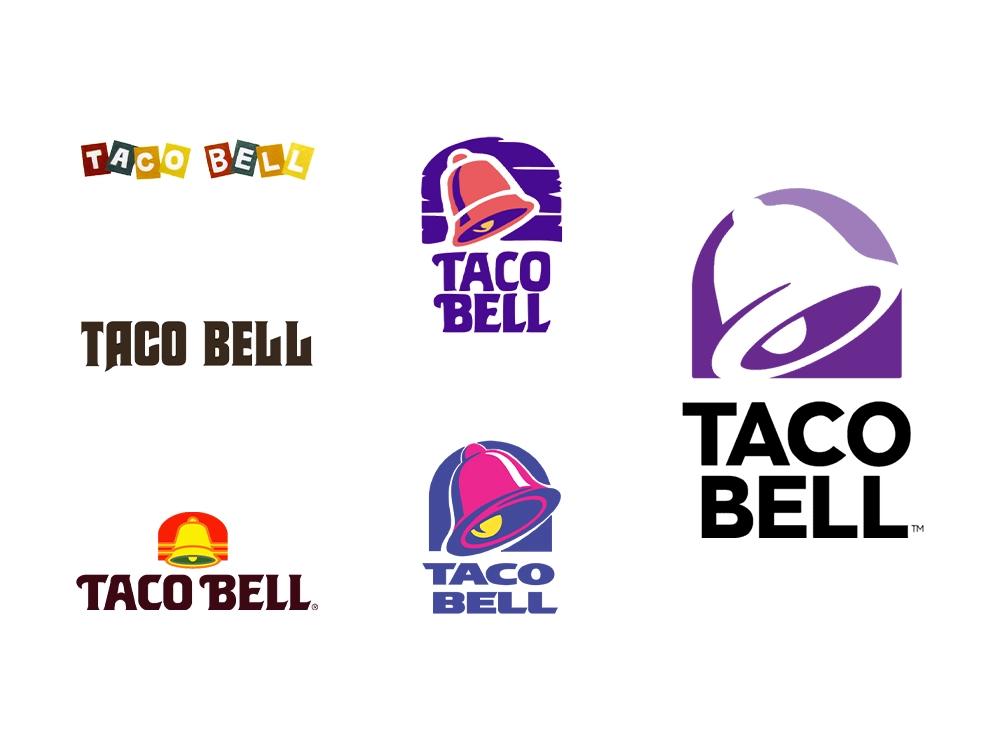
    The branding was bright with a bell and blocks of Vibrant colors that looked like fresh foods like beef, cheese, and lettuce. This was done to get people excited about the idea of healthy, tasty food served quickly. Taco Bell’s early menu included popular foods such as tacos and burritos, offering a quick and inexpensive dining choice for customers.

    As fast food changed, though, Taco Bell had to find a way to stand out from its rivals, such as McDonald’s and Burger King. The company quickly saw that its logo needed to change, too. 

    What caused Taco Bell to change its name?

    The fast food business is very competitive, and Taco Bell knew it had to keep changing in order to stay at the top. From the start, Taco Bell wanted to stand out from other restaurants just like you.

    The company changed its name several times, including Taco Tai and El Taco, before the first official Taco Bell. The change was necessary as customer styles and design trends changed.

    It wasn’t just about how things looked. The changes were also meant to show that they were new and meet the needs of current consumers. Moreover, According to Statista,  44.97% of Americans aged 18 to 29 visited Taco Bell in the past 3 months in 2018. This depicts that their target audience is younger, and that’s why they need to keep updating to stay in the game. 

    Bringing change to your branding is a process of rebranding. If you are not aware of what branding is so, we have covered a detailed blog on it. Click Here to Read!

    How To Be Different To Stand Out?

    Taco Bell introduced how to standout

    When Taco Bell introduced the now-iconic bell logo in the 1990s, along with a bright color scheme of purple and pink, it made a big step forward in its branding. Most fast food chains mainly use standard colors like red and yellow, but Taco Bell chooses to be different to stand out by making a minor change in color preferences.

    The unusually bright colors made Taco Bell look young and lively, which appealed to younger people. This approach worked well because it got people’s attention and helped them remember the brand.

    How modern Style/Design is the clean and simple approach?

    Taco Bell switched

    Taco Bell switched to a more simple design in 2016, making its mark a sleek black-and-white one with softer purple shades. The idea was to follow the minimalist style of the 2010s, which was popular with tech-minded people. People today are constantly being overwhelmed with ads, so Taco Bell used simple, clean designs to stand out without being too much for people to handle.

    Additionally, if you review the History of Taco Bell Logos, it used to be busy. With constant change, the new logo and font are simple and easy to spot both online and offline. They were made to work best on marketing platforms, where keeping things simple is key to being seen.

    Why Taco Bell Made Changes To The Restaurant Experience?

    Redesigning The Inside

    Along with changing its brand image, Taco Bell has also changed the way its restaurants look on the inside. The change from loud, colorful designs to a more stylish and modern look makes it a great spot to hang out and eat.

    Changes To The Packaging

    The way Taco Bell packages its food has also been changed. In rebranding, the designs use the same colors and fonts, which makes the brand look uniform and easy for customers to recognize. Yes, Your Packaging design is as important as the food.

    What’s Else is Different About Taco Bell?

    Menu Updation 

    The food at Taco Bell has always been everyone’s favorite. Customers keep coming back because the brand is always trying new things, like making Doritos Locos Tacos, and veggie options. 

    They often change their menus at the same time that they are rebranding. They make the food and the brand experience one and the same.

    Stay in the Limelight

    One more thing that makes Taco Bell stand out is that it can adapt to changing times. The company is known for its fun ads and collaborations with well-known people from pop culture. 

    These keep the brand in their audience’s eye and appeal to a wide range of young people. This applies to the way the restaurant is designed as well. 

    The Instagram-worthy rooms match the brand’s cool, laid-back vibe. Moreover, It also shows their brand consistency online and offline.

    What can you learn from Taco Bell’s 60 Years of Transformation?

    The process of rebranding Taco Bell shows us that growth requires minor change. Changing things like your brand, menu, or the way your restaurant looks can help you stay competitive and relevant in a market that is always changing. We at Minor Change help restaurants change their branding in a way that people will like and that will help them succeed in the long run. We hear your story and tell it to the world in a way that they can remember for a lifetime. This is what our approach was when we were working on Nick’s Chicken Corner Branding!

    Why You Need to Rebrand?

    Taco Bell’s rebranding worked because it was flexible. If your restaurant’s logo hasn’t been changed in a while, you might want to change how you do things. Getting your brand-new look can help you get new customers. Additionally, it shows that you stand for something and sets you apart from others.

    Minor change believes that minor changes can make a big difference. We’ve learned from Taco Bell’s story that making the right changes at the right time can turn a company into a unicorn.  According to the Statista 2024 update, brand awareness of  Taco Bell is at 89 percent in the United States. 

    Could your business become the next big thing? Contact Minor Change right now to find out what’s possible!

    Note: We are not affiliated with Taco Bell. This information is provided solely as a reference to showcase a case study of rebranding. You can visit the original source here!

  • What Benefits Do You Get From Real Estate Branding in the USA?

    What Benefits Do You Get From Real Estate Branding in the USA?

    No matter what business you have, you need to stand out, especially when you are in a competitive market like real estate. Whether you’re a small brokerage or a solo realtor, building a strong brand can improve your image. Real estate branding is more than just a name or logo. It creates a unique personality in the market, builds trust, and eventually brings you more leads.

    With Real Estate Branding, You can stand out in both the residential and commercial real estate fields.

    Here are the benefits that you can get from real estate branding, but to expect the best lead generation real estate branding benefits, you need to get your branding done by a company that understands branding.

    Makes A Lasting Impression

    Having a branding for your real estate business helps people remember the first time they see it. In the real estate market, it’s important for clients to be familiar with and trust your brand.

    Having a luxury real estate brand makes people remember you and develops lifelong trust. Your target audience will remember you and the story of your business because it will help you stand out from the competition.

    In Minor Change’s branding strategy, we come up with a unique real estate company name and logo that speaks to your target audience. This way, you’ll be recognized for both residential and commercial property branding.

    Right Leads and Clients

    A well-designed real estate brand attracts the right kind of individuals. You may attract buyers, sellers, and investors in your targeted market by combining property branding with real estate agent personal branding. As an example, the goal of commercial real estate branding is to attract business clients, but the goal of luxury real estate branding is to attract high-end clients.

    Branding not only makes it easier to get leads, but it also makes sure that these leads are interested in the same things as your business. This targeted method means getting more qualified clients and leads more quickly.

    Builds Trust

    In real estate, trust is very important. Potential customers are more likely to believe you if they see a professional brand that stays the same. A good real estate brand marketing plan, from the look of your image to the way your website sounds, helps build trust. The real estate company name and logo should show that they are skilled and trustworthy so clients know they can rely on you.

    This is also one of the reasons we focus on building trust for our clients by using consistent branding that lets them know you’ll be honest and do a good job every time.

    Helps You Stand Out from Other Businesses

    Real estate branding helps your business stand out from the others in the same field. Your real estate business will stand out if you come up with unique real estate branding ideas to brand itself. For that, you can focus on eco-friendly homes or a certain area.

    You can set yourself up as an expert in a certain market with customized agent branding and a clear brand message. This will make it easy for clients to choose you over others.

    As a minor change, one of our tactics is to look at what works in the market and come up with a brand identity that is both memorable and depicts your story to the target audience.

    Assist People Find And Interact With You Online

    Most people start looking for property online these days. If you market your real estate brand well, it can help your online visibility and show up in search results for terms like “best lead generation real estate” or “commercial property branding.” Real estate branding helps people find you online by using strategy. This brings potential clients to your website or social media pages.

    Personal Branding For Real Estate Agents

    Personal branding is just as important as commercial property branding. People are more likely to hire an agent with a strong personal brand because they are seen as knowledgeable and trusted. Personal designs, niche-focused social media content, or sharing client success stories are all examples of real estate branding ideas that can be customized to each agent.

    Business Grow In The Long Term

    A long-term investment is real estate branding. Building a strong brand helps businesses grow over time by keeping customers and making them come to you again. From the best logos for real estate to full branding, every part of your brand adds to its long-term value, which brings in new customers and keeps old ones coming back.

    Real estate branding or realtor branding is more than just how something looks. It’s about giving it a personality that clients can relate to. A strong brand brings in qualified leads, builds trust, and helps the industry grow over the long run. Minor Change knows that real estate workers have specific needs. They offer branding solutions that make your business more visible and set it apart in a crowded market.